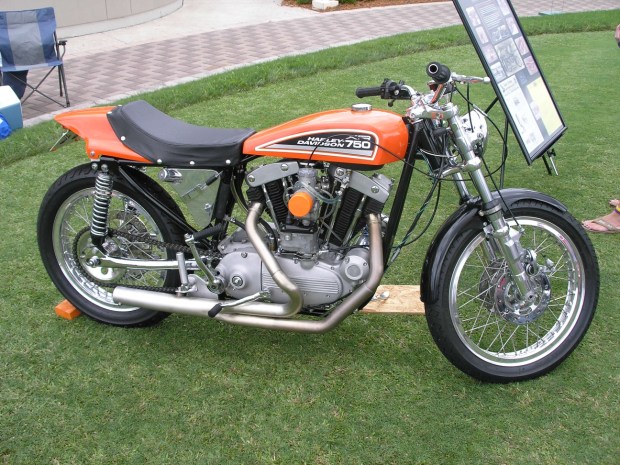
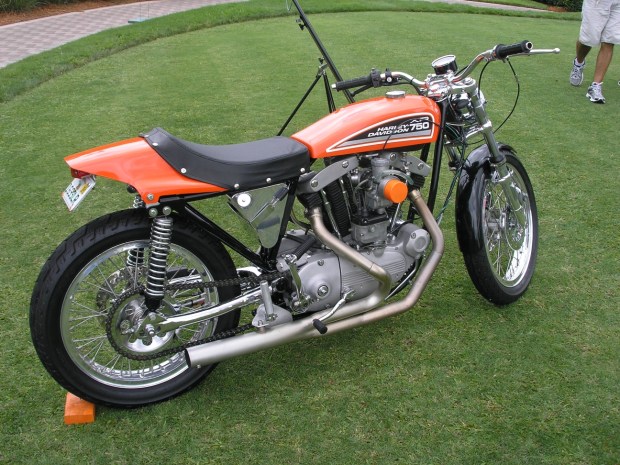
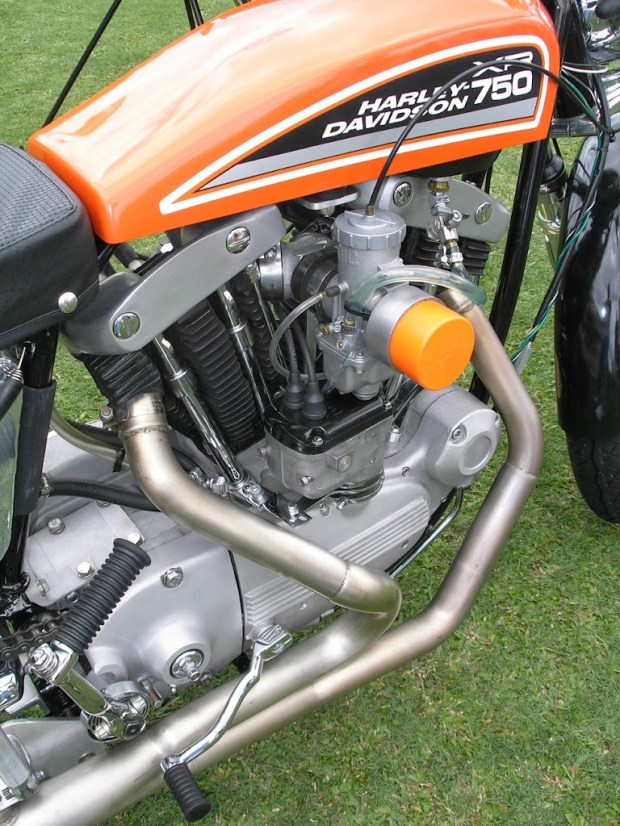
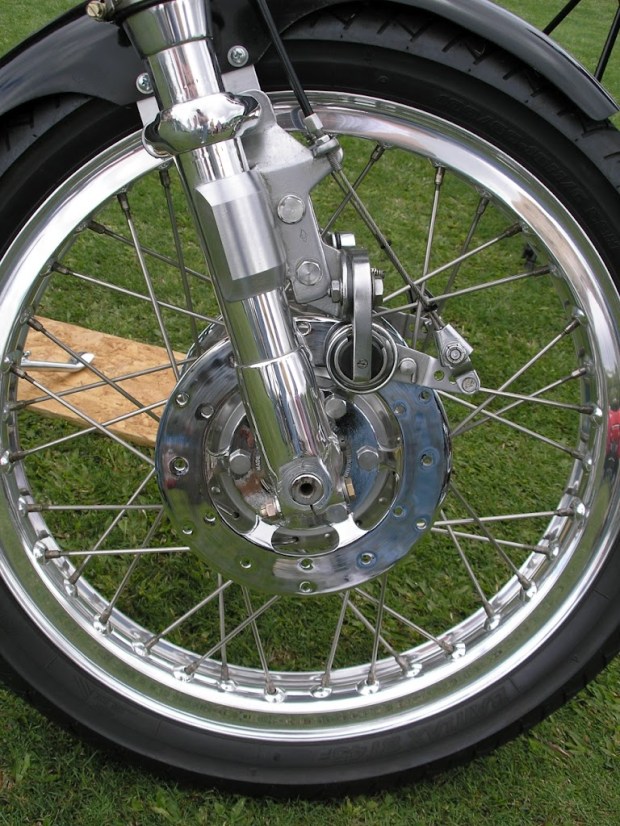
The front disk brake is mechanically actuated, rather than hydraulic. The engine is iron, rather than all-alloy. The intake is via single carburetor rather than via two long intake runners and dual carbs. The wheels are the old style with raised lips that can trap dirt and increase unsprung weight. If this is a factory XR750, it is one of the earliest examples. Those early iron-engined examples weren’t very effective on the track, and they were horribly unreliable. (Sometimes their pistons were known to melt into a ball!)
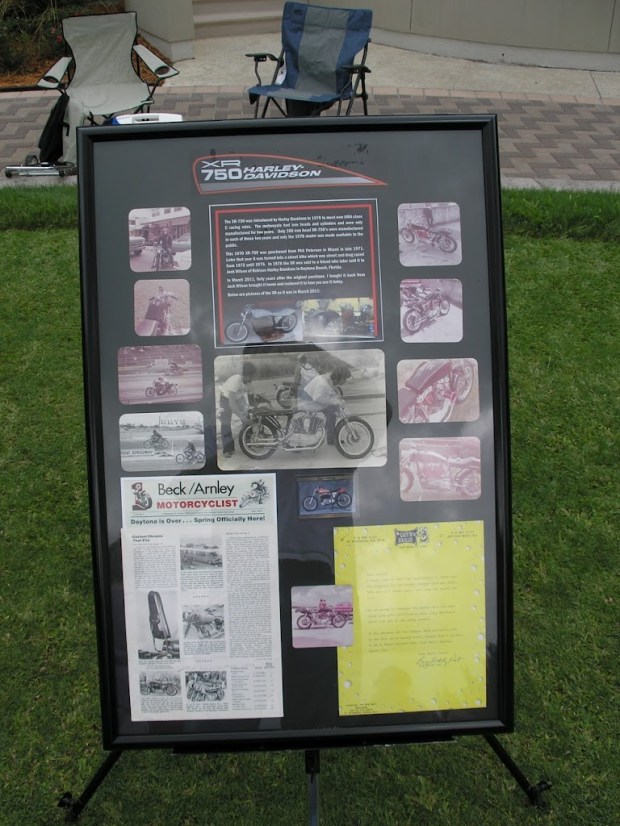
This is an early XR, probably ’69. They were rushed into existence when the AMA changed the flattrack rules to OHV 750, instead of flat head KRs and 500 cc Brit singles and twins. No more Gold Stars! The XRs were NOT set up as street bikes, but many have been converted, with both good and bad results. Reliability problems, racing lower end bearings, and lack of parts availability for iron head XRs is why you don’t see too many. Once they redid the top end and relocated the magneto, it became a whole different animal. Very few Sportster parts will interchange with this bike, even though it looks like one. I don’t think I’d trust that front brake setup a lot, though…
Yes, they used Sporty castings, but were ported for high RPM, and the cams were hotter than XLCH or XLR cams. There were several other internal engine differences, too. I heard they made a couple with 2 front iron heads and 2 carbs, like a Vincent Lightning, but never saw one. The stroke is shorter than an XL, so it revs pretty well, and was a lot faster than the KR flat heads, once they got dialed in. They only ran them for a few years, until the all-alloy 750 that is still used today was ready. They are still the best and winningest 1/2 mile and mile flattrackers out there, as they’ve had 40 years to fine-tune the engine and chassis. The most recent ones have monoshock rear suspension. There are no common parts between the street bike the factory calls the XR1200 and racing XRs.
I have no idea why this particular iron XR has mechanical discs, as I wouldn’t use them on anything bigger than a 250. I’d rather have a lightweight 8″ drum, as they work as well as a disc for normal riding, and are lighter. The DLS drum brake on my Guzzi V7 Sport was every bit as good as my Sportster disc. There are no front brakes on real flat track bikes, however. I saw these early XRs run at the San Jose Mile in ’70 or ’71, along with the first 750 kitted BSA A75s, Triumphs, and Nortons, when I was on the coast. Can’t rermember who won that day, though. It WAS the 70’s…
Just wondering what the setup is with the front fork and the brake / brake caliper? I am torn whether to go big single or twin disc and whether to track down a more period fork or stay with my late 90s Suzuki GSXR1100 non upsidedown fork
I am in the parts acquisition phase for a build of my own, and was going to cut up my recently acquired 96 Sportster 1200 , but recently was made aware of the 79-81 ‘highboy’ Ironhead Sporty frame, so have decided to go down that path (Which suits me fine, as the 96 was a right-place-right-time fairy tail bargain and is almost too nice to cut up, so that will remain my faithful daily)
 Motorcycle Photo Of The Day
One of the few harleys made after the 30s that is even a little bit interesting.
The new one looks pretty cool too. I sat on one at a dealer and it felt pretty good.
Great looking bike, but is that front brake mechanism stock? I don’t think I’ve ever seen one like that before.
The front disk brake is mechanically actuated, rather than hydraulic. The engine is iron, rather than all-alloy. The intake is via single carburetor rather than via two long intake runners and dual carbs. The wheels are the old style with raised lips that can trap dirt and increase unsprung weight. If this is a factory XR750, it is one of the earliest examples. Those early iron-engined examples weren’t very effective on the track, and they were horribly unreliable. (Sometimes their pistons were known to melt into a ball!)
This is an early XR, probably ’69. They were rushed into existence when the AMA changed the flattrack rules to OHV 750, instead of flat head KRs and 500 cc Brit singles and twins. No more Gold Stars! The XRs were NOT set up as street bikes, but many have been converted, with both good and bad results. Reliability problems, racing lower end bearings, and lack of parts availability for iron head XRs is why you don’t see too many. Once they redid the top end and relocated the magneto, it became a whole different animal. Very few Sportster parts will interchange with this bike, even though it looks like one. I don’t think I’d trust that front brake setup a lot, though…
The pipes are on the wrong side for an XR 750. Is that one of the items making it an early XR?
Yes, they used Sporty castings, but were ported for high RPM, and the cams were hotter than XLCH or XLR cams. There were several other internal engine differences, too. I heard they made a couple with 2 front iron heads and 2 carbs, like a Vincent Lightning, but never saw one. The stroke is shorter than an XL, so it revs pretty well, and was a lot faster than the KR flat heads, once they got dialed in. They only ran them for a few years, until the all-alloy 750 that is still used today was ready. They are still the best and winningest 1/2 mile and mile flattrackers out there, as they’ve had 40 years to fine-tune the engine and chassis. The most recent ones have monoshock rear suspension. There are no common parts between the street bike the factory calls the XR1200 and racing XRs.
I have no idea why this particular iron XR has mechanical discs, as I wouldn’t use them on anything bigger than a 250. I’d rather have a lightweight 8″ drum, as they work as well as a disc for normal riding, and are lighter. The DLS drum brake on my Guzzi V7 Sport was every bit as good as my Sportster disc. There are no front brakes on real flat track bikes, however. I saw these early XRs run at the San Jose Mile in ’70 or ’71, along with the first 750 kitted BSA A75s, Triumphs, and Nortons, when I was on the coast. Can’t rermember who won that day, though. It WAS the 70’s…
Just wondering what the setup is with the front fork and the brake / brake caliper? I am torn whether to go big single or twin disc and whether to track down a more period fork or stay with my late 90s Suzuki GSXR1100 non upsidedown fork
I am in the parts acquisition phase for a build of my own, and was going to cut up my recently acquired 96 Sportster 1200 , but recently was made aware of the 79-81 ‘highboy’ Ironhead Sporty frame, so have decided to go down that path (Which suits me fine, as the 96 was a right-place-right-time fairy tail bargain and is almost too nice to cut up, so that will remain my faithful daily)